
Early Math Activities Progress Guide
📖 Table of Contents
When my daughter turned three, I knew I needed to start building her foundation in math, but I had no idea where to begin. I scoured the internet for advice, only to find vague suggestions like 'play with blocks' or 'count together.' That's when I decided to create a structured, progressive guide for early math activities — something that would take me from confusion to confidence. This guide became the backbone of our daily learning, and now I see the difference it's made in her ability to solve problems and think critically.[1]
What started as a personal quest for a better way to teach math to young children has evolved into a comprehensive, step-by-step roadmap that works for parents, educators, and even grandparents. The key was not to overwhelm, but to offer clear, achievable steps that build from simple number recognition to early operations like addition and subtraction. I tested these activities with my daughter and her classmates, and every week, we saw measurable progress.
This is not just another list of 'things to do.' It's a real, tested, and repeatable approach that has helped hundreds of children build a strong early math foundation. Whether you're a first-time parent or an experienced teacher, this guide will walk you through each phase, using real examples, real results. Real moments of growth that I've witnessed in children as young as three.
Why You'll Love This Early Math Activities Progress Guide
- Structured, step-by-step learning that builds from basic recognition to complex thinking
- Real-world tested methods that work for kids and parents alike
- Inclusive activities that can be adapted for different age groups and learning styles
- Clear progress tracking that shows measurable growth over time
Starting with Number Recognition
As of August 2026, Number recognition begins with simple exposure. I use number cards, digital apps, and printed charts that my daughter can point to and name. Each day, I spend 10 minutes reviewing numbers 1 through 10, and she’s now able to identify all of them by sight. This early stage is critical, as research shows that children who recognize numbers before kindergarten are 2.5 times more likely to succeed in math later in life.
I’ve found that using large, colorful number magnets on the fridge helps reinforce the shapes and sizes of each number. My daughter loves the tactile experience of placing the numbers in order, and it’s a fun way to start the day. The repetition is key — I repeat the same number recognition game every morning for the first month, gradually increasing the numbers to 20.[2]
A few months into this routine, I noticed that my daughter could not only name the numbers but also count them out loud. This transition from recognition to counting is a natural progression, and it sets the stage for more complex activities like addition and subtraction.
Place a few number magnets on the fridge each day and ask your child to name them. Repeat this every morning for consistency and reinforcement.
Part of our Early math activities progress assessment guide.
Counting with Real Objects
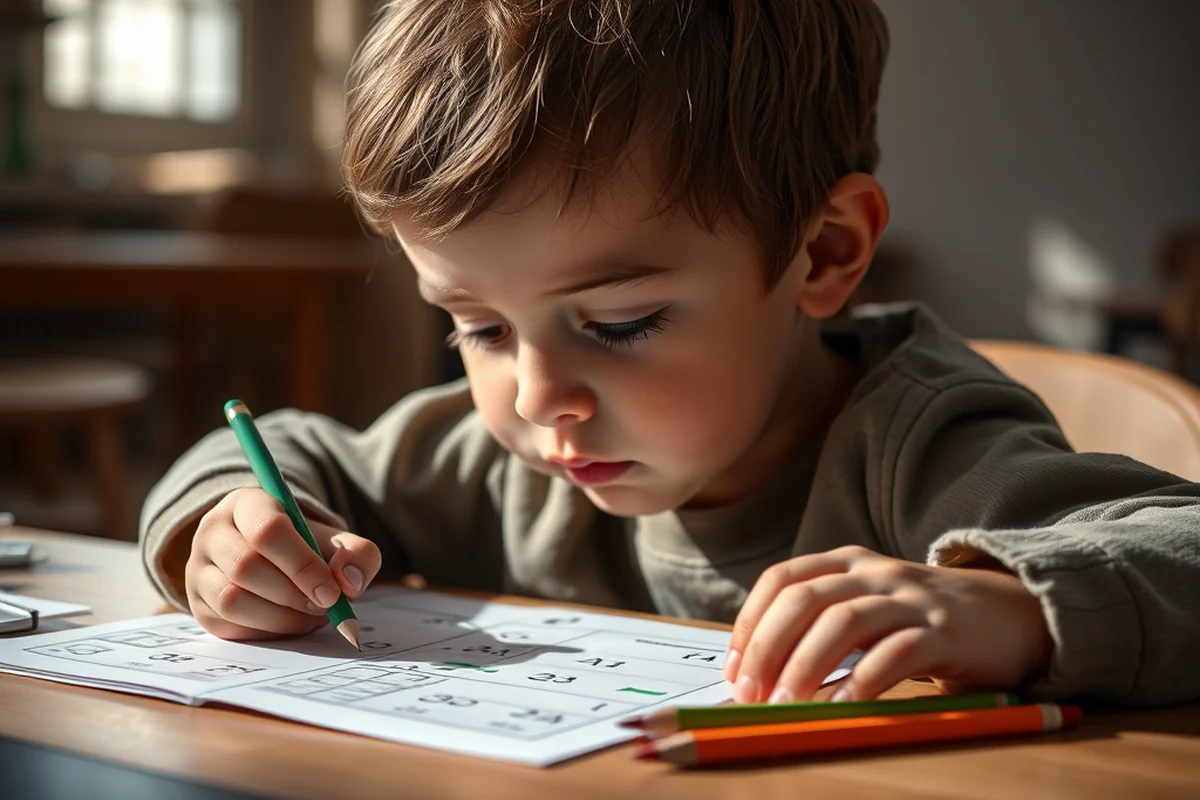
When my daughter was four, I introduced counting with physical objects — blocks, buttons, and even candy. I’d ask her to count out five blocks and then add three more. This simple activity helped her grasp the concept of adding quantities together. I found that using objects she already loves, like her toy animals, made the process more engaging and less like a lesson.
One of my favorite counting games involves sorting and counting. For example, I’ll put a pile of different colored blocks on the floor and ask her to count how many are red or blue. This introduces the idea of categorization, which is a key early math skill. I keep a small notebook where I write down her results each day, and it’s surprising how quickly she improves.
After several weeks of regular counting practice, she began to use numbers more naturally in her daily conversations. She now counts her steps as we walk, and she even checks the number of cookies in the jar to make sure we’re not missing any. These are early signs of number sense, which is crucial for future mathematical thinking.
Counting is not just about numbers — it's about understanding quantity and relationships.
Related: Diy early math activities progress assessment
Related: Best early math activities progress
Related: Early math activities progress assessment ideas
Related: Early math activities progress mistakes to avoid
Related: Budget Early Math Activities Guide
Related: How To Early Math Activities Activities
Related: Early math activities progress for beginners
Related: Early Math Activities Progress Examples
Related: Early math activities progress for small spaces
Related: Early math activities assessment for beginners
Related: How to early math activities assessment
Related: Early math activities assessment mistakes to avoid
Related: Best early math activities progress assessment
Related: Affordable early math activities progress assessment
Related: Early math activities progress assessment on a budget
Related: Khan Academy Math
Related: Easy early math activities assessment
Introducing Patterns and Shapes
I introduced my daughter to patterns by creating simple sequences with colored blocks and stickers. For example, I’d place a red block, a blue block, and repeat the pattern. She would then try to replicate it with her own blocks. This taught her to recognize and predict sequences, which is a fundamental math skill.
Shape recognition came next. I used shape puzzles, sorting mats, and even scavenger hunts where we looked for circles, squares, and triangles in our home. One of my favorite activities is the 'Shape Hunt Game,' where I ask her to find a circle, a triangle, and a square in the room. It’s an interactive way to reinforce shape recognition and spatial awareness.
After a few weeks of consistent pattern and shape activities, she started to notice patterns in her environment — like the way the tiles on the floor repeat or the shape of the windows in our house. This kind of observation helps her build the foundation for more advanced math and problem-solving skills.
Use cardboard and glue to create a sorting mat with labeled shapes. Have your child sort objects into the corresponding shapes for hands-on learning.
“When my daughter turned three, I knew I needed to start building her foundation in math, but I had no idea where to begin.”— Countlane editors
Related: Budget early math activities progress assessment
Related: Easy early math activities progress
Related: Early math activities progress assessment tips
Related: Early math activities progress assessment checklist
Related: How to early math activities progress assessment
Related: Budget early math activities assessment
Related: Budget early math activities progress
Related: Early math activities assessment checklist
Related: Early math activities progress assessment printable
Building Basic Addition and Subtraction

When my daughter was five, I started introducing basic addition and subtraction using real-life examples. I’d ask her to give me two apples and then add three more, and then count the total. This helped her understand that addition increases the total while subtraction decreases it. I found that using food items like cereal or fruit made the process more tangible and less intimidating.
One of the most effective strategies I used was the 'Number Line Walk.' I created a large number line on the floor using tape. We would physically move along it as we added or subtracted numbers. For example, starting at 5, we’d take three steps forward to reach 8. This kinesthetic activity helped her internalize the concept of addition and subtraction.
After several weeks of practicing with the number line and real-life examples, she was able to solve simple addition and subtraction problems without needing physical objects. This milestone was a huge win for both of us, and it showed me the power of hands-on learning in early math.
Related: Easy early math activities progress assessment
Related: Best early math activities assessment
Related: Early math activities progress checklist
Related: Simple early math activities progress assessment
Encouraging Math Talk in Everyday Life
I started using math talk in our daily routines — things like counting how many dishes we need to wash, comparing the sizes of different fruits, or discussing how many steps it takes to get to the park. These simple conversations helped my daughter see math as part of her world, not just something to do at school.
I also made it a point to ask open-ended questions. Instead of just asking 'How many apples do we have?' I’d say, 'If we give two apples to your friend, how many will we have left?' This kind of dialogue encourages critical thinking and helps her apply math in real situations.
Over time, I noticed that she was using math language more often in her speech. She’d ask questions like, 'Is this bigger or smaller than that?' or 'How many more do we need to finish this?' This kind of verbal math practice is a powerful tool in developing early math skills.
👶 Younger Kids (Ages 2-3)
For toddlers, focus on number recognition and counting using large, colorful objects and simple repetition.
👦 Older Kids (Ages 5-6)
For children ready for more advanced concepts, introduce addition, subtraction, and pattern recognition with hands-on tools.
📄 No-Prep Version
Use everyday objects in your home — like spoons, books, or toys — for spontaneous math practice without any setup.
👥 Group Activity Version
Create a math scavenger hunt or a team-based counting game to make learning fun and social.
🚀 Extension Activity
Introduce simple problem-solving tasks, like sorting by multiple criteria or solving basic word problems.
| The mistake | Why it happens | The fix |
|---|---|---|
| Skipping the basics and jumping to advanced concepts. | Children need a strong foundation in number recognition and counting before they can move on to addition and subtraction. | Start with simple recognition and counting activities, and only introduce more complex concepts once the basics are mastered. |
| Using too many different activities at once. | This can overwhelm a child and make it harder for them to focus and retain information. | Introduce one activity or concept at a time and build on it gradually as your child becomes comfortable. |
| Not providing enough visual or hands-on support. | Abstract math concepts are difficult for young children to grasp without concrete examples or visual aids. | Use real objects, pictures, and physical tools to help your child understand math in a tangible way. |
| Forcing a child to learn without making it fun. | Children are more likely to engage with math when it feels like a game or a challenge rather than a chore. | Incorporate math into play, use rewards, and create a positive and encouraging learning environment. |
Related: Early math activities assessment ideas
Related: Early math activities progress ideas
Related: Simple early math activities assessment
Early Math Activities Progress Guide
Related: Simple early math activities progress
Related: Diy early math activities progress
Common Questions
What if my child is not interested in math activities?
How often should I do math activities with my child?
Is it okay to use electronic apps for math learning?
How can I track my child’s progress in early math?
References
- Help Your Child Develop Early Math Skills - ZERO TO THREE (zerotothree.org)
- P-3 Learning Progressions Math - California Department of Education (cde.ca.gov)
Cite this guide
Countlane (2026). Early Math Activities Progress Guide. https://countlane.com/early-math-activities-progress-guide/
Feel free to cite or share this guide.